When Should Kids Have Their First Eye Exam? A Parent’s Guide by Age
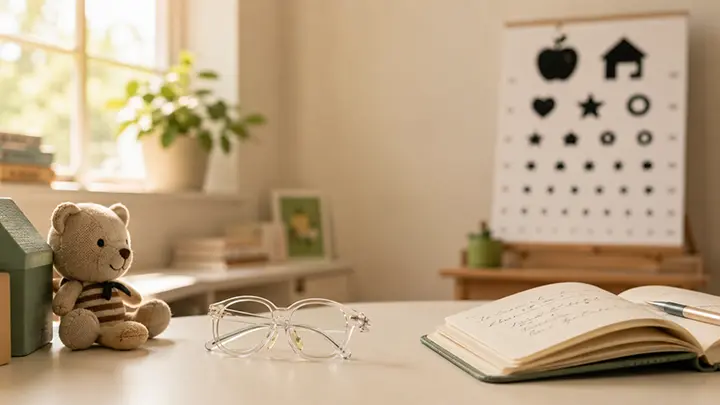
Most parents take their child to the dentist at three, the pediatrician every year, and the eye doctor — maybe — when something looks wrong. Vision problems in young children often have no obvious symptoms. Here’s the schedule eye-care bodies actually recommend, what’s checked at each age, and the signs that say go sooner.
You’ve probably noticed that pediatricians do a brief vision check at well-child visits. So you might assume that covers it — that if there were a problem, it would show up.
Sometimes that’s true. Often it isn’t. The screenings at the pediatrician’s office catch some issues, but they were never designed to replace a comprehensive eye exam, and they miss things a trained eye-care professional would catch. Children rarely complain about their vision because they don’t know what “normal” looks like — they assume everyone sees the way they do.
This article walks through when kids should have their first eye exam and every exam after, what’s checked at each age, the signs that warrant an earlier visit, and the practical things you can do at home between exams.
The Recommended Eye Exam Schedule for Children
Two of the main professional bodies — the American Optometric Association (AOA) and the American Academy of Pediatrics (AAP) — publish guidance on when kids should be examined. Their recommendations differ slightly but converge on a similar timeline.
- At birth and at well-baby visits. The pediatrician checks the structure of the eye, the red reflex, and basic alignment. This catches obvious conditions like congenital cataracts, but it’s a screen, not a full exam.
- Around 6 to 12 months. The AOA recommends a first comprehensive eye exam in this window. In the US, the InfantSEE program offers this free of charge through participating optometrists. Most parents skip it because the baby seems fine. It’s a useful safety net, not a must-do.
- Around age 3. A second comprehensive check before preschool. By this age the visual system is rapidly developing, and conditions like amblyopia (“lazy eye”) and strabismus (eye misalignment) are easier to treat the earlier they’re caught.
- Before starting school, around age 5–6. This is the exam most eye-care bodies treat as non-negotiable. Roughly 80% of what kids learn comes through their eyes, and undiagnosed vision problems are one of the most common hidden causes of struggles with reading and attention.
- Every 1–2 years through school age. Once a child is in school, an exam every year or every other year is the standard — sooner if a problem is noticed or if the child already wears a prescription.
The American Academy of Pediatrics is slightly less prescriptive — they recommend regular vision screenings at well-child visits and a referral to a specialist if anything is flagged. In practice, the schedule above gives you a more complete picture and isn’t expensive when you space it out.
Why the First Exam Matters Earlier Than You’d Think
Three vision conditions are dramatically easier to treat in young children than later: amblyopia, strabismus, and uncorrected refractive errors that affect learning.
Amblyopia develops when one eye doesn’t send a clear image to the brain during early childhood, often because of a difference in prescription between the two eyes. The brain learns to ignore the weaker eye. If it’s caught and treated before about age 7, vision in the weaker eye can usually be brought up to near-normal with patching or atropine drops. After 7, the window narrows. Beyond about 12, full correction is rare.
Strabismus — when the eyes don’t align properly — has similar timing. Earlier treatment, usually with glasses, patching, eye exercises, or occasionally surgery, gives a much better outcome.
Refractive errors like nearsightedness, farsightedness, and astigmatism don’t cause permanent harm, but uncorrected they can affect school performance and quality of life. A child who can’t see the board doesn’t always say so. They might look like they’re not paying attention, or they might stop trying.
There’s a fourth reason, especially relevant now: myopia progression. Childhood-onset nearsightedness usually gets worse year by year through the teen years. The earlier it’s detected, the earlier interventions like specific contact-lens types, low-dose atropine drops, or behavioural changes can be discussed with the eye doctor. We covered what the research shows in our guide on can smartphones cause myopia.
Signs Your Child Needs an Eye Exam Sooner
Even if your child isn’t due for their scheduled exam, any of the following is reason to book one within a few weeks. Kids rarely volunteer that something’s wrong — these are the indirect tells:
- Sitting very close to the TV, or holding a book or phone unusually close to the face
- Squinting to see clearly, especially at school or while watching shows
- Tilting the head or covering one eye when looking at something
- Rubbing the eyes frequently, particularly after reading or screen time
- Complaints of headaches, especially toward the end of the day or after school
- Eyes that appear to drift — one eye turning in, out, up, or down
- Sensitivity to light that’s new or unusual
- Avoidance of close-vision activities like reading, drawing, or puzzles
- A drop in school performance that doesn’t have another obvious explanation
A single sign isn’t a diagnosis — kids squint and rub their eyes for plenty of harmless reasons — but a pattern is worth investigating.
Pediatrician Screening vs. Full Eye Exam — What’s the Difference?
Many parents assume the eye check at the pediatrician’s office covers what a full exam would. It doesn’t, and the difference matters.
A pediatric vision screening is a brief test, often a letter or symbol chart at a fixed distance, sometimes supplemented with a simple photo-screening instrument. It’s designed to flag the most obvious problems and is meant to be quick. The American Academy of Pediatrics acknowledges that screenings catch a meaningful portion of vision issues — but miss others, including small refractive errors and early amblyopia.
A comprehensive eye exam by an optometrist or pediatric ophthalmologist takes 30–60 minutes and includes refraction (the prescription test), an eye-health assessment of the front and back of the eye, eye movement and teaming, depth perception, colour vision, and an actual look at the structures inside the eye. Some exams include drops that dilate the pupil so the doctor can see the retina clearly.
The two complement each other. The pediatrician’s screening at every well-child visit is useful. It just isn’t a substitute for a periodic comprehensive exam.
What to Expect at a Pediatric Eye Exam
Parents often worry that their child is too young to “do” an eye exam. Pediatric optometrists and ophthalmologists do this work every day and have age-appropriate methods for toddlers and preschoolers — pictures instead of letters for kids who can’t read, eye-tracking observations for infants, and patient demonstrations for hesitant kids.
A typical visit looks roughly like this:
- A short conversation about the child’s vision history, family eye health, and any concerns you’ve noticed
- A check of how the eyes move and work together
- A measurement of how clearly each eye sees, using charts, shapes, or pictures
- A refraction to determine if glasses would help — sometimes done with drops in younger children
- An external and internal eye-health check, possibly including dilation
- A conversation at the end about findings and any next steps
A first exam without dilation usually takes about 30 minutes. With dilation, plan for closer to an hour, plus a few hours of light sensitivity afterward — sunglasses help.
What You Can Do at Home Between Exams
Eye exams catch what’s already there. Day-to-day habits influence what develops between exams — especially for myopia, which is rising rapidly in school-age children worldwide.
- Outdoor time matters more than most parents realize. Spending at least 1–2 hours a day outdoors is associated with a measurably lower risk of childhood myopia. The mechanism isn’t fully understood — daylight intensity is the leading hypothesis — but the association is consistent across studies.
- Screen distance is the under-the-radar factor. Reading or watching a screen at 15–20 cm forces the focusing system to work much harder than at 30–40 cm, and prolonged near-focus is a strong correlate of myopia progression. For the specifics on how close is too close, see our guide on how far kids should hold their phone from their eyes.
- Breaks during close work. Reading, homework, drawing, gaming — any sustained near task benefits from a brief look at something far away every 15–20 minutes.
- Lighting. Doing close work in dim light pulls the head closer to the page or screen and tires the eyes. Adequate room light plus a desk lamp for homework is the simple fix.
- Sleep and overall health. Tired eyes do worse on vision tests and feel more strained generally. The whole-body habits that make a healthy kid make healthier eyes too.
For a broader picture of what good screen habits look like at this age, our guide on best screen habits for kids under 12 goes deeper.
The “hold the phone further” message is famously hard to enforce. Kids drift back in within minutes — not because they’re defying you, but because they don’t notice. This is the gap iVisionGuard was built to fill: a free Android app that uses the front camera as a distance sensor and alerts your child the moment the phone gets too close, running quietly in the background. The reminder lives on the device, so you’re not the one repeating it.
Key Takeaways
- The recommended schedule: a baby exam around 6–12 months (free via InfantSEE in the US), a comprehensive exam around age 3, another before starting school, then every 1–2 years through the school years
- Pediatrician vision screenings are useful but are not a substitute for a periodic comprehensive eye exam
- Amblyopia and strabismus are dramatically more treatable when caught before age 7 — early exams matter most for these
- Watch for indirect signs: sitting close to screens, squinting, headaches, head tilting, eye rubbing, drops in school performance
- A full eye exam takes 30–60 minutes; pediatric optometrists have age-appropriate methods for toddlers and preschoolers
- Outdoor time, healthy screen distance, and regular breaks during close work are the home-side habits that influence eye health between exams
Frequently Asked Questions
At what age should my child have their first eye exam?
Most professional bodies recommend a first comprehensive exam between 6 and 12 months (free in the US via InfantSEE), a second around age 3, and another before starting school. In practice, the pre-school exam is the one parents skip the least, and it catches most of what matters at that age.
How often should kids have their eyes checked after that?
Every 1–2 years through the school-age years, depending on the doctor’s recommendation. Children with an existing prescription, a family history of eye problems, or a noticed change may be seen more frequently.
Will the pediatrician catch any vision problem during well-child visits?
The pediatrician’s vision screening catches obvious issues but misses others — particularly small refractive errors and early amblyopia. It’s a useful screen, not a comprehensive exam.
What if my child can’t read the letters on the chart yet?
Pediatric optometrists use pictures, shapes, and matching games for preschoolers, and behavioural observation for infants. Age is rarely a barrier to a meaningful exam — they do this every day.
Does my child need their eyes dilated?
Sometimes. Dilation lets the doctor see inside the eye clearly and helps produce an accurate prescription in young children. The aftereffect — light sensitivity for a few hours — is mild. Bring sunglasses for the ride home.
Is screen time bad for my child’s eyes?
Screen time itself isn’t damaging at typical doses, but the way screens are used can be — particularly close viewing distance and long stretches of unbroken near work. We covered what the research actually shows in our guide on can smartphones cause myopia.
iVisionGuard is a free Android app for real-time eye protection — monitoring screen distance automatically so the phone reminds your child to hold it at a safe distance, not you. Learn more at ivisionguard.com.