Can Smartphones Cause Myopia? What the Research Says
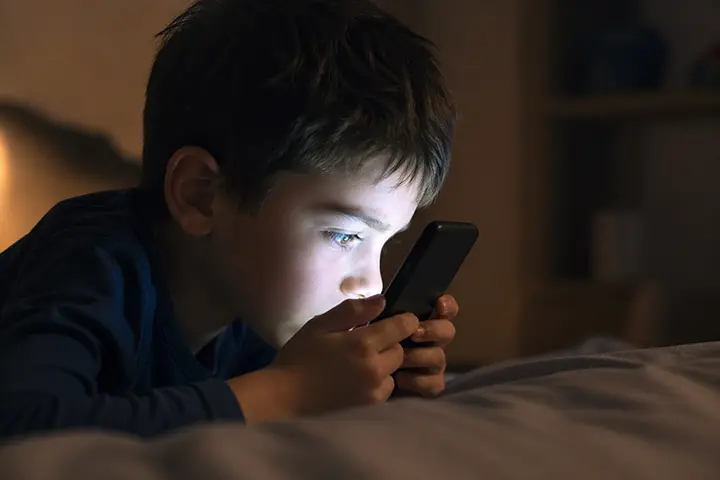
Myopia rates in children have doubled in a generation. Smartphones arrived at roughly the same time. Here’s what the research actually says about the connection — and what it means for your child.
If you’ve noticed your child squinting at the board at school, or if their optometrist has mentioned myopia for the first time, you may have wondered: is the phone doing this?
It’s a reasonable question. The timing is striking. Childhood myopia has increased dramatically over the past three decades — exactly the period during which personal screens went from novelty to constant companion. The correlation is visible in the data. Whether smartphones cause myopia, however, is a more precise question than it might appear — and the answer matters for what you do about it.
What Is Myopia and Why Does It Matter?
Myopia, or nearsightedness, is a refractive error in which the eye focuses light in front of the retina rather than on it. The result is clear vision up close and blurred vision at a distance. It’s typically caused by the eyeball growing slightly too long during development — a structural change that, once established, is permanent.
Mild myopia is inconvenient. High myopia — severe nearsightedness that develops or progresses significantly — carries more serious long-term implications, including increased risk of retinal detachment, glaucoma, and macular degeneration later in life.
For parents, the significance is this: myopia that develops in childhood tends to worsen progressively through the teenage years. The earlier it starts, the more it typically progresses. Habits formed before age 12 have a disproportionate influence on how severe myopia becomes — which is why the question of what’s driving it matters so much.
The Myopia Epidemic: What the Numbers Show
The scale of the increase is difficult to overstate.
A comprehensive analysis published in the British Journal of Ophthalmology in 2024, drawing on 276 studies, found that global myopia prevalence in children has risen from approximately 24% in the early 1990s to around 36% today. The same research projects that figure will reach nearly 40% — over 740 million children — by 2050.
In East Asian countries, where smartphone penetration is highest and educational near-work demands are most intense, the numbers are even more striking. Studies in South Korea, China, and Singapore have found myopia rates among school-age children exceeding 80–90% in some urban populations.
The rate of increase is the telling detail. Genetics changes slowly. Myopia rates have changed fast — too fast to be explained by hereditary factors alone. Something in the environment has changed. The question is what.
What the Research Says About Smartphones and Myopia
Near-work: the established mechanism
The relationship between close-range visual work and myopia development is not new. Research on near-work and myopia predates smartphones by decades, beginning with studies on reading, sewing, and other sustained close-focus activities.
The proposed mechanism is called form deprivation myopia and lens-induced myopia: when the eye is consistently focused at close range for extended periods, signals sent to the developing eyeball may promote elongation — the structural change that causes nearsightedness. The eye, in a sense, adapts to the visual demand being placed on it.
Smartphones intensify this mechanism in a specific way: they are held closer than books, televisions, or computers. Studies measuring actual holding distances find that children hold smartphones at 15–20 cm on average — significantly closer than the 30–40 cm recommended by eye doctors, and closer than most other near-work activities.
At 15 cm, the eye’s focusing muscles are working considerably harder than at 35 cm. This difference in accommodative demand is directly relevant to the mechanisms associated with myopia progression.
What the clinical studies show
Multiple large-scale studies have examined the relationship between screen use and myopia in children:
A 2021 systematic review and meta-analysis published in Ophthalmology — pooling data from 3,990 participants across multiple countries — found that screen time was associated with higher odds of myopia in children, with the association strongest for smartphone use specifically, compared to television or computer use. The authors attributed this partly to the closer viewing distances typical of smartphone use.
A 2023 study published in JAMA Ophthalmology examined myopia rates in children during COVID-19 lockdowns — a natural experiment in which screen time increased dramatically and outdoor time decreased sharply. Researchers found accelerated myopia progression during lockdown periods compared to pre-pandemic rates, with the effect most pronounced in children aged 6–8.
Research from the Brien Holden Vision Institute has modelled the contributions of near-work and reduced outdoor time to the global myopia epidemic, concluding that both are significant independent risk factors — and that they frequently co-occur, compounding their effects.
The direct causation question
Here the research is precise about what it can and cannot claim. Most studies in this area are observational — they measure associations between screen use and myopia rather than experimentally isolating smartphones as a cause.
The ethical and practical obstacles to a randomised controlled trial are obvious: you cannot randomly assign children to years of heavy smartphone use to measure the effect. What the observational evidence establishes is a consistent, dose-dependent association between close-range screen use and myopia risk — meaning children who use smartphones more, and who hold them closer, show higher rates of myopia development and faster progression.
This is the same quality of evidence that links smoking to lung cancer before direct causation was definitively established experimentally. The association is strong, consistent across populations, and biologically plausible. Most paediatric ophthalmologists and the major vision research bodies treat near-work at close distances as a significant modifiable risk factor for childhood myopia — not a proven direct cause in every case, but a meaningful contributor in the context of the evidence.
What Else Contributes to Childhood Myopia?
Smartphones are not operating in isolation. The myopia epidemic reflects a combination of factors that have shifted simultaneously:
Genetics
Children with two myopic parents have roughly a six-fold higher risk of developing myopia than children with no myopic parents. Genetics establishes baseline susceptibility. But it doesn’t explain the rapid increase in prevalence — the gene pool hasn’t changed enough to account for doubling rates in one generation. Environmental factors are acting on a genetically susceptible population.
Reduced outdoor time
This is the most consistently supported protective factor in myopia research. Exposure to natural light — specifically the intensity and spectral properties of outdoor light — stimulates retinal dopamine release, which is believed to inhibit the excessive eye elongation associated with myopia development.
Multiple large cohort studies have found that children who spend at least two hours outdoors daily have significantly lower rates of myopia onset, independent of how much near-work they do. In countries where school programmes have deliberately increased mandatory outdoor time, myopia rates have measurably stabilised.
Smartphones contribute to myopia risk not only through direct near-work effects but indirectly — by displacing outdoor time. A child spending three hours on a phone is, in most cases, spending three fewer hours outside.
Educational near-work demands
High academic workloads — particularly reading-intensive homework — have long been associated with elevated myopia rates in children. East Asian educational systems, with their emphasis on intensive study from early childhood, correlate with the world’s highest myopia rates. This near-work contribution predates smartphones and is not diminished by them.
Urban vs. rural environment
Children in urban environments consistently show higher myopia rates than those in rural settings, across all countries studied. Researchers attribute this partly to less outdoor time, partly to more near-work, and partly to architectural factors — spending time in enclosed spaces with limited long-distance viewing opportunities.
What This Means for Parents: The Practical Takeaways
The research doesn’t support panic, but it does support action. The environmental contributors to myopia are, unlike genetics, modifiable. Here’s what the evidence points to:
Screen distance matters more than screen time
Duration of screen use is one variable. Distance is another — and it’s the one most consistently linked to accommodative demand and myopia risk.
Reducing screen time from two hours to one hour while maintaining a holding distance of 15 cm achieves less than maintaining two hours at a safe distance of 35 cm. Managing both variables is the goal. Managing only time while ignoring distance leaves a significant portion of the risk unaddressed.
The structural approaches that work: increasing font size (removes the instinct to bring the screen closer), using phone stands for video watching, establishing no-lying-down rules for phone use, and using automatic distance monitoring tools that alert your child in real time when the phone is too close. For a detailed breakdown of each approach, see our guide on how far kids should hold their phone from their eyes.
iVisionGuard is a free Android app that monitors screen-to-face distance continuously using the front camera, and alerts your child immediately when they hold the phone too close. It runs in the background across all apps, works fully offline, and never records or stores any video. The Plus version adds PIN-locked settings so children can’t disable alerts without a parent’s authorisation.
Prioritise outdoor time
Two hours of outdoor time daily is the most evidence-supported protective intervention for childhood myopia — more consistently supported, in fact, than any screen restriction. Natural light exposure is protective regardless of what the child does outdoors. Walking, playing, or simply sitting outside all count.
For parents managing competing demands on a child’s time, this framing helps: outdoor time isn’t just exercise or fresh air — it’s a specific, evidence-based intervention for eye health.
Earlier is better
Myopia that develops at age 7 has more years to progress than myopia that develops at 11. Habits established before myopia appears — safe screen distance, outdoor time, limited close-range sessions — are more valuable as prevention than as management after the fact.
This is not a reason for alarm about your six-year-old’s occasional phone use. It is a reason to establish sensible defaults early, before habits calcify. Our guide to best screen habits for kids under 12 covers the specific routines with the strongest evidence behind them.
Regular eye exams
Myopia in children frequently goes undetected because children don’t always recognise or report blurred vision — they have no reference point for how things should look. Annual eye exams for children who use screens regularly, or who show any signs of squinting or sitting close to screens, allow early detection and appropriate management.
The Bottom Line
Do smartphones cause myopia? The most accurate answer is: close-range screen use is a well-established risk factor for myopia development and progression in children, and smartphones — held closer than any other screen — intensify that risk more than other devices.
This is not the same as saying every child who uses a smartphone will develop myopia, or that smartphones are the sole cause of the current epidemic. Genetics, reduced outdoor time, and educational near-work all contribute. But among the modifiable factors — the ones parents can actually influence — screen distance and outdoor time are the two with the strongest evidence behind them.
The research gives parents a clear and actionable message: the distance your child holds their phone matters, and two hours outside every day matters. Both are achievable without dramatically restricting screen use.
Frequently Asked Questions
Can smartphones directly cause myopia in children? The research establishes a consistent association between close-range smartphone use and myopia development in children, not direct causation in every case. The mechanism — sustained near-work at close distances promoting eye elongation — is biologically plausible and well-supported by observational studies. Most paediatric ophthalmologists treat close-range screen use as a significant modifiable risk factor.
Do phones cause more myopia than books or computers? Smartphones are associated with higher myopia risk than television or computer use in several studies, primarily because they are held significantly closer to the eyes. The closer the device, the greater the accommodative demand on the eye muscles. Holding a phone at 15 cm creates more strain than reading a book at 30 cm.
At what age is myopia risk highest from smartphone use? Research identifies the period between ages 6 and 12 as the highest-risk window for myopia onset, when the eye is most actively developing. Habits established during this period have a disproportionate influence on whether myopia develops and how quickly it progresses. See our full guide on screen habits for children under 12 for age-specific recommendations.
Can outdoor time counteract smartphone myopia risk? Studies show that two hours of outdoor time daily significantly reduces myopia risk, independent of how much near-work a child does. Natural light exposure appears to have a protective effect on eye development. It doesn’t fully counteract unlimited close-range screen use, but it’s the most consistently evidence-supported protective intervention available.
Is there an app that monitors screen distance to reduce myopia risk? Yes. iVisionGuard is a free Android app that monitors the real-time distance between your child’s face and the screen, alerting them when they hold the phone too close. It runs automatically in the background, works fully offline, and with Plus includes PIN-protected settings so children can’t disable it. It’s available free on Google Play.
References
- Liang J, Pu Y, Chen J, et al. Global prevalence, trend and projection of myopia in children and adolescents from 1990 to 2050: a comprehensive systematic review and meta-analysis. British Journal of Ophthalmology. 2024;109(3):362–371.
- Holden BA, Fricke TR, Wilson DA, et al. Global Prevalence of Myopia and High Myopia and Temporal Trends from 2000 through 2050. Ophthalmology. 2016;123(5):1036–1042.
- Foreman J, Salim AT, Praveen A, et al. Association between digital smart device use and myopia: a systematic review and meta-analysis. The Lancet Digital Health. 2021;3(12):e806–e818.
- Xiong S, Sankaridurg P, Naduvilath T, et al. Time spent in outdoor activities in relation to myopia prevention and control: a meta-analysis and systematic review. Acta Ophthalmologica. 2017;95(6):551–566.
- World Health Organization. World report on vision. 2019.
- National Eye Institute. Nearsightedness (Myopia).
iVisionGuard is a free Android app for eye protection — monitoring screen distance in real time to help reduce the risk factors associated with myopia in children. Download free on Google Play or learn more at ivisionguard.com.