Screen Time and Eye Health in Teenagers: What Parents Need to Know
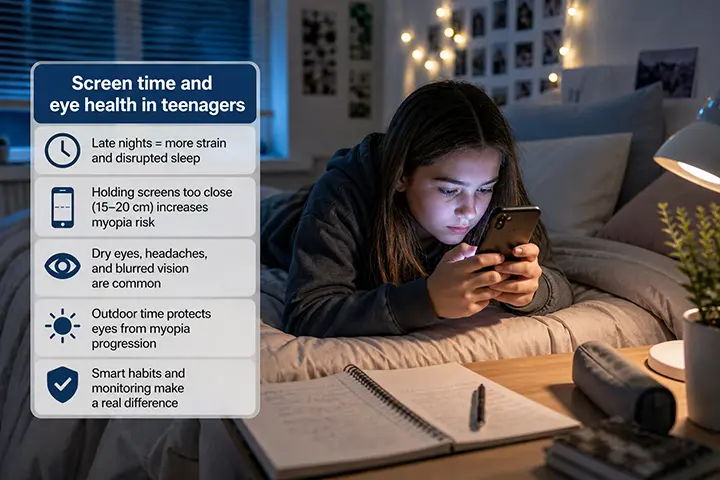
Teenagers use screens differently than younger children — more independently, later at night, and in ways that are much harder for parents to monitor. Here’s what that means for their eyes, and what actually helps.
If you’ve already established screen habits with your child before they became a teenager, you may feel like the hard work is done. In some ways it is. But adolescence introduces a new set of challenges that make eye health more difficult to manage — not because the risks are different, but because the context is.
A 12-year-old uses a phone under some degree of supervision. A 16-year-old uses it alone in their room at midnight, lying on their back, with the screen 15 cm from their face, for two hours before falling asleep.
The biology is the same. The oversight isn’t.
Why Teenagers Are a Distinct Category
Most conversations about children and screen time focus on younger children — under 10, under 12. The guidelines, the parental control tools, the pediatric recommendations. Teenagers tend to fall through the gap: too old for the strict frameworks designed for young children, but still in a developmental window where eye health decisions have long-term consequences.
Several factors make teenagers specifically vulnerable:
Greater independence. Teenagers use devices unsupervised for longer periods, in more varied settings, and at times of day when parental oversight is absent. The phone goes to bed with them. It’s the last thing they look at before sleeping and often the first thing they reach for in the morning.
Social pressure. Teenage screen use is tied to social connection in a way that younger children’s use is not. Limiting a 10-year-old’s YouTube time is a parenting decision. Limiting a 15-year-old’s access to the platforms where their peer relationships exist is a more complicated intervention with real social costs.
Physical habits. Teenagers are more likely to use phones lying down, in dark rooms, for extended sessions. These are the conditions that combine maximum accommodative strain (phone close to face) with maximum blue light impact (dark room, late at night) and minimum blink rate (absorbed in content).
Myopia window. The eyes are still developing through mid-adolescence. Myopia typically onset between ages 7 and 12, but it continues to progress — sometimes rapidly — through the teenage years. The habits formed at 13, 14, and 15 directly influence how severe that progression becomes.
How Screen Time Affects Teenage Eye Health
Digital eye strain: the immediate problem
Digital eye strain — also called computer vision syndrome — is the most common and immediate consequence of heavy screen use in teenagers. Symptoms include eye fatigue and soreness, headaches (particularly around the temples and forehead), blurred vision during or after screen use, dry and irritated eyes, and difficulty shifting focus from near to far.
Studies estimate that digital eye strain affects up to 70% of teenagers who use screens for three or more hours daily. Given that average daily screen time for teenagers in the US and UK consistently measures between 7 and 9 hours, the exposure is significant.
Most teenagers don’t report these symptoms clearly — they describe them as «tired eyes», «headaches after school», or «things going blurry at night». The connection to screen use is often not made explicitly, and symptoms are frequently attributed to other causes.
Myopia progression: the longer-term risk
For teenagers who have already developed some degree of myopia — which, given that roughly one in three children worldwide is myopic, includes a large proportion of the teenage population — screen habits directly influence the rate of progression.
Myopia progresses when the eyeball continues to elongate. The mechanisms driving this elongation are still being researched, but sustained near-work at close distances consistently emerges as a significant factor. Research published in JAMA Ophthalmology found that myopia progression was measurably accelerated during periods of intensive close-range screen use — most notably during COVID-19 lockdowns, which created a natural experiment in high-volume, close-range screen use with reduced outdoor time. For a detailed look at what the research shows, see our guide on can smartphones cause myopia.
The clinical implication: a teenager who already wears glasses or contact lenses for myopia, and who spends several hours daily with a phone held at 15–20 cm, is likely progressing faster than they would with better screen habits. Each unit of progression means a stronger prescription — and at high myopia levels, increased long-term risk of retinal complications.
Night-time phone use: a compounding factor
Late-night phone use creates a specific combination of risks that amplifies both eye strain and myopia concerns.
In a dark room, the pupil dilates to let in more light. A bright screen viewed by a dilated pupil in an otherwise dark environment creates significantly more contrast stress than the same screen in a lit room. This is one reason why eyes feel more fatigued after night-time phone use than the same duration of use during the day.
Blue light emitted by screens suppresses melatonin production — the hormone that regulates the sleep-wake cycle. In teenagers, whose circadian rhythms are already shifted toward later sleep times by biological changes in adolescence, evening screen use compounds this delay. Poor sleep has downstream effects on everything including how fatigued the visual system feels the following day, creating a cycle where tired eyes lead to more close-range screen use which leads to worse sleep which leads to more tired eyes.
A study published in Pediatrics found that teenagers who used screens in the hour before bed took significantly longer to fall asleep and reported lower sleep quality — independent of total screen time. The timing matters as much as the duration.
How Much Screen Time Is Too Much for Teenagers?
There is no single universal limit, and the major health organisations have moved away from simple hour-based guidelines for teenagers. The American Academy of Pediatrics updated its position to focus on the quality and context of screen use rather than hours alone — recognising that two hours of video calling family is different from two hours of passive social media scrolling at midnight.
That said, the research points to some practical thresholds:
For eye health specifically, unbroken sessions of more than 20–30 minutes without a distance break are associated with measurable accommodative fatigue. This is the basis of the 20-20-20 rule — every 20 minutes, look at something 20 feet away for 20 seconds. The rule applies at any age, but teenagers are the least likely to follow it spontaneously.
For myopia risk, total daily near-work load matters — the cumulative hours spent in close-range focus across school, homework, and recreational screen use. Researchers increasingly discuss «near-work dose» as a meaningful variable, with higher doses associated with faster myopia progression. There is no clean threshold, but the trend is consistent: more close-range hours, faster progression.
For sleep and overall health, screens in the hour before bed are consistently associated with worse outcomes regardless of total daily screen time. This is probably the single most evidence-supported limit to set — not «two hours a day» but «not in the hour before bed».
The Screen Distance Problem in Teenagers
Screen distance is the variable that receives the least attention in conversations about teenagers and eye health — and arguably the one with the most direct impact.
Eye doctors recommend holding smartphones at 30–40 cm from the eyes. Research measuring actual holding distances in teenagers finds averages of 15–20 cm — with the shortest distances occurring when lying down, which is precisely how most teenagers use their phones in the evenings and at night.
At 15 cm, the accommodative demand on the eye’s focusing muscles is roughly double what it is at 30 cm. Over several hours of daily use, this difference in muscle load is substantial — contributing directly to eye fatigue, headaches, and, in the context of continuing eye development, myopia progression.
The challenge with teenagers is that the structural interventions that work well for younger children — phone stands, parental supervision, enforced rules — are less practical. A 15-year-old is not going to use a phone stand while lying in bed. A parent cannot monitor every evening’s phone session.
This is where automated tools become particularly relevant for teenagers. iVisionGuard monitors real-time screen-to-face distance on Android and alerts the user immediately when they hold the phone too close — running in the background across all apps, without requiring supervision or willpower. For teenagers with some degree of autonomy, an automatic alert that doesn’t require parental intervention is often more practically effective than rules that depend on compliance.
The Plus version includes PIN and biometric-locked settings, meaning parents can set the parameters without the teenager being able to disable them — relevant for the period when habits are still forming and buy-in isn’t complete.
For a broader look at how screen distance compares to screen time as a variable, see our guide on how far kids should hold their phone from their eyes.
Outdoor Time: Still the Most Underused Intervention
The research on outdoor time and myopia prevention is robust across all age groups — and teenagers are no exception. Two hours of outdoor time daily, in natural light, consistently shows a protective effect against myopia progression independent of how much near-work the individual does.
The mechanism is well-established: natural light stimulates retinal dopamine release, which inhibits the excessive eye elongation associated with myopia. The intensity of natural light — even on an overcast day, outdoor light is 10–50 times brighter than typical indoor lighting — appears to be the critical variable.
For teenagers, this is both the most evidence-supported recommendation and the hardest to implement. Teenage lifestyles in many countries involve increasing amounts of time indoors — school, homework, social screen time, gaming. The combination of high near-work load and low outdoor exposure is precisely the environmental profile associated with the fastest myopia progression.
Even 30–60 minutes of outdoor time daily, if consistently maintained, provides measurable benefit. Walking to school, outdoor lunch breaks, after-school physical activity — any time in natural light counts, regardless of activity.
Practical Strategies for Parents
Managing a teenager’s screen habits requires a different approach than managing a younger child’s. Direct restriction often backfires — it creates conflict, drives use underground, and doesn’t build the self-regulation that teenagers need as they approach adulthood. The goal shifts from enforcement to environment design and education.
Have the conversation once, clearly
Most teenagers don’t know that screen distance matters more than screen time for eye health. They’ve heard «too much screen time is bad for your eyes» — but they haven’t heard that holding the phone at 15 cm is more damaging than holding it at 35 cm for the same duration. This is genuinely new information that many teenagers will engage with if presented without moralising.
A single direct conversation — «here’s what the research shows about distance vs. time» — is more likely to produce lasting change than repeated reminders to put the phone down.
Target the highest-risk behaviour specifically
Rather than broad screen time limits, identify and address the highest-risk specific behaviour. For most teenagers, that’s phone use lying down in a dark room before bed. This one context combines the closest holding distances, the worst lighting conditions, the most disruptive blue light timing, and the least parental visibility.
A specific, targeted rule — «phone charges outside your room after 10pm» — is more achievable and more impactful than a general «less screen time» instruction.
Use structural defaults rather than willpower
Increase font size on the teenager’s phone — the single most effective intervention for screen distance because it removes the primary reason to bring the screen closer. Enable night mode to activate automatically after 8pm. Set the screen to reduce brightness automatically in the evening.
These changes happen once and work continuously without requiring the teenager’s ongoing cooperation.
Annual eye exams
Teenagers with myopia should be seen annually. Progression during adolescence can be rapid, and updated prescriptions are important both for visual function and for monitoring whether additional interventions (myopia control lenses, atropine drops) are appropriate. For teenagers without diagnosed myopia, biennial exams are reasonable if no symptoms are present.
Signs That Warrant an Eye Exam
Watch for these indicators, which may suggest eye strain, uncorrected refractive error, or progressing myopia:
- Squinting to see the board at school or screens at a distance
- Frequent headaches, particularly after school or screen use
- Complaints that things look blurry in the evening
- Sitting unusually close to screens or holding devices very close
- Losing their place while reading or needing to re-read passages
- Eye rubbing during or after screen use
- Reporting that one eye sees differently from the other
Many teenagers normalise these symptoms or don’t connect them to vision — they simply stop trying to see the board clearly, or assume everyone’s eyes feel like this after a long day. An annual exam catches changes that self-reporting misses.
Key Takeaways
- Teenagers are a distinct risk category for eye health — greater independence, night-time use, and social pressure create conditions that are harder to manage than younger children’s screen use
- Digital eye strain affects an estimated 70% of teenagers using screens three or more hours daily; symptoms are frequently underreported or misattributed
- Myopia continues to progress through adolescence, and close-range screen habits are a significant modifiable risk factor for progression rate
- Night-time phone use in dark rooms compounds both eye strain and sleep disruption — screens in the hour before bed is the highest-impact single behaviour to target
- Screen distance (30–40 cm) is at least as important as screen time duration — and for teenagers who use phones lying down, distance is typically far below the recommended threshold
- Automated distance monitoring, outdoor time, and targeted environmental defaults are more practically effective for teenagers than broad screen time restrictions
Frequently Asked Questions
How much screen time is too much for a teenager’s eyes? There is no single universal limit. For eye health specifically, unbroken sessions longer than 20–30 minutes without a distance break cause measurable accommodative fatigue. More relevant than total hours is the combination of holding distance, session length, and time of day — particularly avoiding close-range screen use lying down in dark rooms before bed.
Can screen time damage a teenager’s eyes permanently? Digital eye strain symptoms are temporary and reversible. However, sustained near-work at close distances during adolescence is associated with accelerated myopia progression — which is a permanent structural change. Teenagers who already have myopia and maintain poor screen distance habits are likely to progress faster toward higher prescriptions, with associated long-term risks.
Does the 20-20-20 rule work for teenagers? Yes — regular breaks reduce accommodative fatigue effectively at any age. The challenge is that teenagers are the least likely to follow the rule spontaneously. Timers and environmental cues work better than self-monitoring during absorbed screen use.
How can I get my teenager to hold their phone further away? Direct instruction rarely produces lasting change. More effective approaches: increase font size (removes the reason to hold it close), have a single clear conversation about why distance matters more than time, use automatic distance monitoring that alerts without requiring parental supervision, and target the highest-risk specific context (night-time use in bed) rather than all screen use broadly.
Is there an app that monitors screen distance for teenagers? Yes. iVisionGuard is a free Android app that monitors screen-to-face distance in real time and alerts users when they hold the phone too close. It runs in the background across all apps without requiring ongoing interaction. The Plus version includes PIN-locked settings, allowing parents to set parameters that teenagers cannot override. Available free on Google Play.
iVisionGuard is a free Android app for real-time eye protection — monitoring screen distance automatically so teenagers don’t have to think about it. Download free on Google Play or learn more at ivisionguard.com.