The 20-20-20 Rule: Does It Actually Work?
Every optometrist recommends it. Every “reduce eye strain” article mentions it. But what does the research actually say about the 20-20-20 rule — and is it enough on its own?
If you’ve ever complained about tired eyes from screen use, someone has probably told you about the 20-20-20 rule. It’s the most widely cited piece of advice in the digital eye health space, repeated in doctor’s offices, productivity blogs, and phone manufacturer help pages around the world.
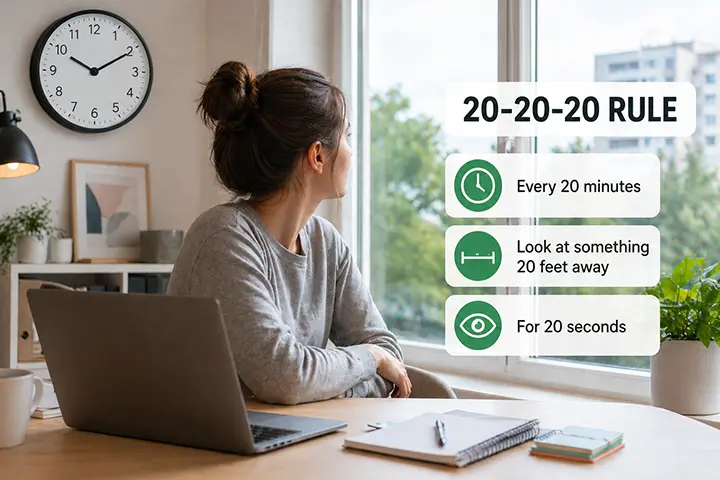
The rule is simple: every 20 minutes, look at something 20 feet away for 20 seconds. Done.
But simple advice isn’t always complete advice. Here’s what the evidence actually shows — what the 20-20-20 rule does well, where it falls short, and what you need alongside it for real protection.
What Is the 20-20-20 Rule?
The 20-20-20 rule is a guideline for reducing digital eye strain during prolonged screen use. The numbers are a mnemonic device designed to make the habit easy to remember:
- Every 20 minutes — the interval between breaks
- Look at something 20 feet away — approximately 6 metres, far enough to fully relax the eye’s focusing muscles
- For 20 seconds — the minimum duration needed for meaningful muscle relaxation
The rule is attributed to California optometrist Dr. Jeffrey Anshel, who developed it in the 1990s as a practical framework for patients struggling with eye fatigue from early computer use. It has since been endorsed by the American Optometric Association, the American Academy of Ophthalmology, and most major vision health bodies.
The Science Behind It: Why Breaks Help
To understand why the 20-20-20 rule works, you need to understand what happens to your eyes during screen use.
Accommodative fatigue
Your eye focuses using the ciliary muscle — a ring of muscle surrounding the lens that contracts to focus on near objects and relaxes for distant ones. During screen use, this muscle holds a sustained contraction for the entire session. Like any muscle held in one position for a long time, it fatigues.
This fatigue manifests as the classic symptoms of digital eye strain: blurred vision, difficulty shifting focus, a heavy or aching sensation behind the eyes, and headaches. The longer the unbroken screen session, the more pronounced these symptoms become.
Looking at a distant object — 20 feet or further — allows the ciliary muscle to fully relax. At distances beyond approximately 6 metres, the eye is in its natural resting state, requiring no active focusing effort. Twenty seconds is enough time for this relaxation to occur.
Reduced blink rate
A less-discussed but equally important mechanism: people blink significantly less during screen use — dropping from a normal rate of 15–20 blinks per minute to as few as 5–7. Blinking spreads the tear film that keeps the eye’s surface lubricated. Less blinking means faster evaporation, leading to dryness, irritation, and the gritty sensation many screen users experience.
Taking a 20-second break away from the screen naturally increases blink rate and allows the tear film to recover.
Does the 20-20-20 Rule Actually Work?
The honest answer: yes, for what it’s designed to do — but it addresses only one part of the problem.
What the research shows
A 2013 study published in Ophthalmic and Physiological Optics examined the effect of scheduled rest breaks on accommodative fatigue in screen users. Participants who took regular breaks showed significantly less ciliary muscle fatigue than those who worked continuously. The break intervals in the study were consistent with the 20-20-20 framework.
A 2023 randomised controlled trial published in Contact Lens and Anterior Eye specifically tested the 20-20-20 rule in office workers over four weeks. Participants who followed the rule reported measurable reductions in eye strain symptoms compared to the control group — with the effect most pronounced for headaches and end-of-day eye fatigue.
The mechanism is well-established and the clinical evidence supports the rule’s effectiveness for its stated purpose: reducing accommodative fatigue and the symptoms of digital eye strain during prolonged near-work.
What it doesn’t address
Here’s where most articles stop — and where the incomplete picture begins.
The 20-20-20 rule manages how long your eyes focus continuously at close range. It does nothing about how close that range is.
A person following the 20-20-20 rule perfectly — pausing every 20 minutes, looking into the distance, resuming — but holding their phone at 15 cm throughout each 20-minute session is still placing their eye muscles under significantly more strain than someone holding the same phone at 35 cm.
Screen distance and break frequency are independent variables. Both matter. The 20-20-20 rule optimises one and ignores the other.
Eye doctors recommend holding smartphones at 30–40 cm from the eyes. Most people hold them at 18–25 cm — particularly when lying down, which is when a large proportion of smartphone use occurs. At 15 cm, the accommodative demand on the ciliary muscle is roughly double what it is at 30 cm. No break schedule compensates for sustained near-work at that distance.
For a detailed look at why screen distance matters and how to manage it, see our guide on digital eye strain symptoms and how to prevent them.
The 20-20-20 Rule for Kids: Does It Apply?
The rule applies to children, but with important modifications and a critical additional concern.
Shorter intervals for younger children
Children under 8 shouldn’t be using screens in unbroken 20-minute sessions to begin with. For this age group, natural breaks — switching activities, playing, eating — typically provide adequate rest without needing a formal rule. For children aged 8–12 who are using screens for homework or entertainment, the 20-20-20 rule is appropriate and worth introducing explicitly as a named habit.
The myopia dimension
For children, digital eye strain is not the only concern. Sustained near-work at close distances is associated with myopia progression — the structural eye elongation that causes nearsightedness. The 20-20-20 rule reduces accommodative fatigue but does not directly address the mechanisms linked to myopia development.
The interventions with the strongest evidence for myopia prevention in children are safe screen distance and outdoor time — not break frequency. Two hours outside daily, combined with holding screens at 35 cm or further, has more consistent support in the myopia research than any break schedule.
This means the 20-20-20 rule is a useful addition to a child’s screen habits, but it’s not the primary lever. For a complete framework of screen habits for children, see our guide on best screen habits for kids under 12.
How to Actually Follow the 20-20-20 Rule
The rule’s main weakness isn’t scientific — it’s behavioural. When you’re absorbed in work, a game, or a video, 20 minutes passes without notice. Self-monitoring fails precisely when focus is highest.
Practical methods that work
Recurring timer: The simplest approach. Set a 20-minute repeating timer on your phone or watch. When it fires, look away for 20 seconds before dismissing it. Takes 30 seconds to set up, works indefinitely.
Pomodoro technique overlap: If you already use the Pomodoro technique (25-minute work blocks), the intervals are close enough that your break serves double duty — use the first 20 seconds of each break looking into the distance before doing anything else.
Screen-based reminders: Several apps display a gentle overlay reminder every 20 minutes. The limitation is that the reminder appears on the same screen causing the strain — but it works for users who respond well to visual prompts.
Physical environment cues: Position your desk near a window. The presence of a visible outdoor view makes it easier to naturally glance into the distance during micro-pauses in work.
What 20 seconds at 20 feet actually looks like
Twenty feet is further than most indoor spaces allow. In practice, looking out a window, down a corridor, or across a large room achieves the same effect — the goal is simply to shift focus beyond the approximately 6-metre threshold where the ciliary muscle fully relaxes. If you’re in a small space, looking at the ceiling works. The direction doesn’t matter; the distance does.
The Complete Picture: What Works Together
The 20-20-20 rule is one component of effective screen eye health management — not a complete solution. Here’s how it fits with the other evidence-based interventions:
Break frequency (20-20-20 rule): Reduces accommodative fatigue and blink-related dryness. Well-supported, easy to implement. Addresses the duration dimension of near-work strain.
Screen distance (30–40 cm): Reduces accommodative demand per unit time. Addresses the intensity dimension of near-work strain. For children, the variable most linked to myopia risk. Requires structural support — phone stands, larger font size, or automatic distance monitoring — because distance drifts during absorbed use.
Outdoor time (2 hours daily for children): The strongest evidence-based intervention for myopia prevention. Natural light exposure has a direct protective effect on eye development independent of screen use.
Screen brightness and glare management: Reduces contrast strain and associated headaches. Lower-effort adjustment with meaningful impact.
For parents managing their children’s screen distance automatically, iVisionGuard monitors real-time face-to-screen distance on Android and alerts children immediately when they hold the phone too close — running in the background across all apps without requiring any ongoing supervision. It addresses the distance dimension that the 20-20-20 rule leaves uncovered.
Key Takeaways
- The 20-20-20 rule — every 20 minutes, look 20 feet away for 20 seconds — is well-supported by research for reducing digital eye strain symptoms
- It works by allowing the ciliary muscles to relax after sustained near-focus, and by restoring the blink rate and tear film
- The rule addresses break frequency but not screen distance — the two are independent variables that both contribute to eye strain
- For children, screen distance and outdoor time have stronger evidence for myopia prevention than break frequency alone
- The rule is most effective as part of a broader approach: regular breaks + safe viewing distance + outdoor time for children
Frequently Asked Questions
What is the 20-20-20 rule? The 20-20-20 rule is a guideline for reducing digital eye strain: every 20 minutes of screen use, look at something at least 20 feet (6 metres) away for 20 seconds. This allows the eye’s focusing muscles to relax after sustained near-work.
Does the 20-20-20 rule actually work? Yes — clinical studies support its effectiveness for reducing accommodative fatigue and eye strain symptoms. However, it addresses only one variable (break frequency) and does not manage screen distance, which is an independent contributor to eye strain and myopia risk.
How do I remember to follow the 20-20-20 rule? A recurring 20-minute timer is the most reliable method. Set it once and let it run. Apps that display on-screen reminders also work, though the reminder appearing on the screen itself is a minor limitation.
Does the 20-20-20 rule prevent myopia in children? The rule reduces eye muscle fatigue but is not the primary intervention for myopia prevention. Research most consistently supports safe screen distance (30–40 cm) and two hours of outdoor time daily as the variables with the strongest protective effect against childhood myopia progression.
What counts as 20 feet for the 20-20-20 rule? Approximately 6 metres — far enough that the eye’s focusing muscles are fully relaxed. In practice, looking out a window, down a long corridor, or across a large room achieves the same effect. The goal is distance, not a specific direction.
Is the 20-20-20 rule enough on its own? No. It’s a useful and well-supported habit, but it doesn’t address screen distance — which is the variable most directly linked to accommodative strain intensity and, in children, myopia risk. Combining regular breaks with safe viewing distance covers both dimensions of the problem.
iVisionGuard is a free Android app that monitors screen-to-face distance in real time — addressing the dimension of eye strain that the 20-20-20 rule doesn’t cover. Download free on Google Play or learn more at ivisionguard.com.